
Punjab & Regional
Exhibition Stall Builders in Multan, Faisalabad & Bahawalpur
A practical guide for exhibitors in Multan, Faisalabad and Bahawalpur: what the venues are usually like, how to design for them, and how a stand built in our Karachi, Lahore or Islamabad units reaches your show floor in one piece.
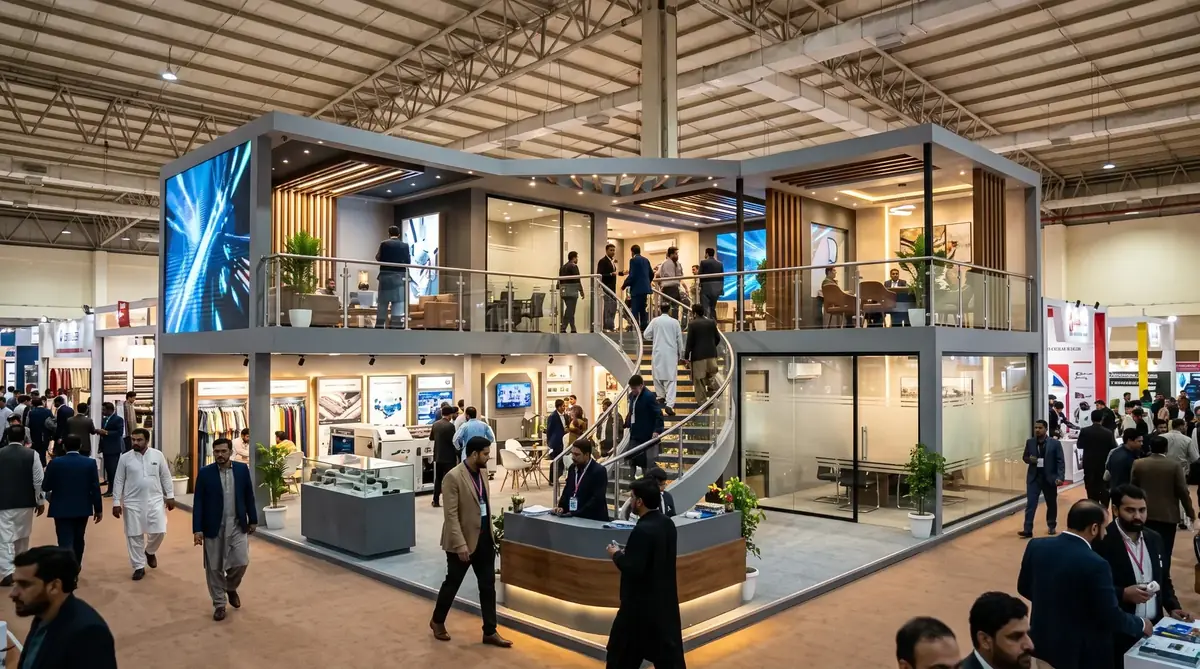 Regional
How regional shows differ
Why Stands for Multan, Faisalabad and Bahawalpur Need a Different Brief
Big-city halls like Expo Centre Karachi come with fixed hall plans and organizer manuals. Regional shows vary far more: chamber of commerce halls, hotel ballrooms, agricultural fairgrounds and temporary marquees are all common. The stand has to cope with whatever the venue turns out to be.
A stand that looks perfect in a rendered exhibition hall can struggle in a hotel ballroom with one service lift, or on an open fairground where the ground is uneven. So before we draw anything, we ask three plain questions. What kind of space is it? How will the panels get in? What will power and lighting really look like on the day?
That is why we plan regional builds as transportable, modular-friendly structures: built and quality-checked in our in-house fabrication units (Karachi, Lahore or Islamabad), packed in sections, installed by our crew on site and taken down quickly after the show.
| City | Typical venue types | Key stand consideration | Common exhibitors |
|---|---|---|---|
| Multan | Hotels, convention spaces, regional fairs | Quick set-up in rooms with limited loading access | Agriculture, cotton, food, ceramics and crafts |
| Faisalabad | Industry and chamber events, manufacturing expos | Reinforced floors and open counters for samples and machinery | Textile, garments, machinery, chemicals |
| Bahawalpur | Agricultural and cultural fairgrounds, some outdoor sites | Weatherproofing and stable anchoring | Agriculture, dairy, handicrafts, local enterprise |
Multan
Exhibition Stalls for Multan Trade Fairs
Multan sits in one of Punjab’s richest farming belts and has long been a trading town. Mangoes, cotton and the city’s blue pottery are what most people associate with it, and that mix shows up in who exhibits: agri-businesses, food and beverage producers, farm-input suppliers and craft makers selling beyond the city.
Trade events here are often held in hotels, convention spaces and chamber halls rather than one purpose-built exhibition centre. That makes the room you are given a better guide to the stand than the city itself.
What tends to work on a Multan stand
- Product first, graphics second: for produce, packaged food and farm inputs, visitors want to see, hold and taste. A clean sampling counter at the front, with products at hand height, usually does more than a huge printed backdrop.
- Surfaces that wipe clean: around any food counter, sealed laminates and easy-clean finishes beat fabric, which stains and holds odours.
- Light for craft: blue pottery and handmade goods depend on glaze and texture. Warm, even spot lighting on shelves shows them far better than a flat overhead wash.
- Built for heat: summers in south Punjab are punishing and hall cooling varies. LED lighting adds little heat, and an open front keeps visitors lingering instead of walking through.
Getting a stand into a Multan venue
Hotels and convention spaces rarely have a loading dock. Ask about lift size, door widths and loading hours before fabrication starts, so we can size panels to fit the route. Many hotels also forbid drilling into floors and walls, so we design freestanding structures where needed.
If you exhibit at several regional shows, a reusable modular exhibition booth usually costs less per show. Our custom vs modular guide works through the numbers, and the stall design service page explains how the stand is approved in 3D first.
A sensible layout for an 18 sqm Multan stand
For a 3m x 6m stand, put the sampling or demo counter at the aisle edge, keep shelving along the back wall, and give the brand name a tall feature wall above eye level. Closed storage sits behind the feature wall, out of sight. Keeping the front open matters more than adding extra furniture, because most visitors decide in a few seconds whether to step in.
Questions to ask the Multan organizer
- What is the space: a hotel hall, a ballroom, a chamber hall or a marquee?
- What are the loading hours, lift size and door widths along the route?
- Are product sampling and food displays allowed, and is there power for refrigeration?
- Is there backup power if the supply drops during the show?
Faisalabad
Exhibition Stalls for Faisalabad Textile and Industrial Expos
Faisalabad is Pakistan’s best-known textile city, and its exhibitions follow its industry: fabric and yarn, garments and home textiles, dyes and chemicals, and the machinery and spare parts that keep mills running. Visitors at these events are usually trade buyers who know exactly what they are looking for.
They also want to handle the product. A stand that is mostly a graphic wall tends to underperform, while one with working surfaces tends to produce longer conversations and better leads.
What tends to work on a Faisalabad stand
- Sample-friendly surfaces: low tables, hanging rails and swatch walls let buyers compare fabrics side by side.
- Honest lighting: colour shifts under very warm or tinted light, so use neutral lighting wherever fabric and garments are on show.
- Strong bases for heavy items: machinery and industrial supplies need reinforced display plinths and a frame that carries the load. Check the venue’s floor limits early.
- Room to talk business: a small semi-enclosed meeting corner, with storage underneath for sample books, suits buyers who negotiate at the stand.
Planning for more than one show
Textile and industrial exhibitors often show in other cities too. If the stand is built in sections, the same frame can move from a Faisalabad chamber hall to Expo Centre Karachi with only the graphics changing. See the Karachi exhibitions calendar for upcoming shows, and our fabrication process for how sectional builds are made.
A sensible layout for an 18 sqm Faisalabad stand
Place a sample table or hanging rail along one open side so buyers can handle the product without entering the stand. A meeting corner with two or three seats sits at the back, with sample books stored below. For machinery, keep the demonstration unit near the front and route cables under covers so aisles stay clear and safe.
Questions to ask the Faisalabad organizer
- What floor load can the hall carry, and where are the limits?
- What power supply is available for machinery demonstrations?
- Can samples and machinery stay on the stand overnight, and is the hall secured?
- What are the move-in and move-out windows, and are there size limits for deliveries?
Bahawalpur
Exhibition Stalls for Bahawalpur Agricultural and Cultural Fairs
Bahawalpur’s economy leans on agriculture, and the region is known for Cholistan handicrafts such as embroidery and pottery. Exhibitors here include farm and dairy businesses, local enterprises and craft sellers.
Fairs often use open grounds or semi-outdoor structures, and visitors are frequently local families and traders rather than a closed trade audience. People pass quickly, so a stand has to explain itself at a glance, and it has to survive the weather.
What tends to work on a Bahawalpur stand
- Weather first: wind, dust and heat decide the materials. Sealed surfaces, covered cable runs and graphics on durable media keep the stand looking sharp for the whole fair.
- Anchoring that suits the ground: concrete, grass and sand each need a different approach, such as weighted bases or ground anchors. Tell us what the ground is and we plan around it.
- Bold, simple signage: a clear brand name and a one-line offer, readable from a distance, with a wide open front.
- Protect what you display: handicrafts and farm products need closed storage and covers for after hours.
- Power you can rely on: grounds often depend on generators, so plan backup lighting and avoid hanging everything on one circuit.
If the fair runs into the evening
Dusk changes how a stand looks. Warm accent lighting on the product and the brand name keeps the stand visible once natural light drops, and it pulls walk-in visitors across the aisle. The installation team checks lighting and power on site before the fair opens.
A sensible layout for an 18 sqm Bahawalpur stand
Keep the open front facing the main walking route, with a bold name board above it. Products sit on low display units that can be covered at night, and storage is closed and raised off the ground against dust. A simple canopy or roofed section gives shade for staff and for visitors who stop to talk.
Questions to ask the Bahawalpur organizer
- Is the ground concrete, grass or sand, and is any of it covered?
- Is there a roof or shade structure, or is the stand fully open to the weather?
- Is power from the grid or from generators, and is there a backup?
- What are the opening hours, and is stock safe on site overnight?
How it works
How a Regional Build Works With Us
- Brief: send the city, venue type (hall, hotel or open ground), show dates, stand size and your branding files through the contact page.
- Design and approval: we prepare a floor plan and a 3D booth design, and flag venue constraints such as lifts, drilling rules or ground type before you sign off.
- Fabrication: the stand is built and quality-checked in our in-house units in Karachi, Lahore or Islamabad. Fabrication generally takes two to five weeks, depending on size and complexity.
- Transport and installation: the stand travels in sections and our crew assembles it on site, checking power and lighting before the show opens.
- Dismantling: after the show we take the stand down within the organizer’s deadline, and can plan reuse if the build is modular.
Allow extra time for transport and for any venue clearance. For a custom stall, briefing us six to eight weeks before move-in leaves room for design approval and fabrication.
Before you book
Planning Checklist for Regional Shows
Confirm the venue type early
Indoor hall, hotel space or outdoor ground changes materials, lighting and anchoring.
Ask for the access window
Loading times and route decide how large each panel can be.
Check power and backup
Regional venues may rely on generators; plan lighting accordingly.
Design in sections
Panels that split into transportable pieces reduce damage and install time.
Allow transport time
Stands travel from the fabrication unit that builds them, so add buffer days to your schedule.
Cost and related pages
What a Regional Stall Costs
Base fabrication cost is the same nationwide. What changes the total is distance, venue type and timing: transport to the city, crew time on site, backup power where a venue needs it, outdoor weatherproofing, and rush schedules. A regional stand of a given size sits in the same bands as everywhere else.
For ranges, use the Pakistan exhibition stall cost guide and the size table in the Karachi stall cost guide. If you are unsure which size you need, the stall size guide shows what fits in 9, 18 and 36 sqm.
Questions
Regional Exhibition Stall FAQ
Yes. We design and fabricate at our in-house units in Karachi, Lahore or Islamabad, then transport and install at the venue.
In our in-house fabrication units in the basements of our Karachi, Lahore and Islamabad offices. Finished stands are transported to the venue and installed by our crew.
Two to five weeks is standard, depending on size and complexity. Allow extra time for transport and for venue access arrangements.
Yes. We plan weatherproofing, anchoring and lighting for outdoor or semi-outdoor sites. Tell us whether the ground is concrete, grass or sand so we can plan the anchoring.
If you plan it as modular sections, yes. Ask us to design for reuse, and only the graphics need reproducing for the next show.
We can design freestanding structures that do not need fixing to floors or walls. Share the venue’s rules when you brief us so we can plan around them.
The base fabrication cost is the same nationwide. Transport distance, on-site crew time, venue type and the notice period can change the total. The Pakistan cost guide shows the ranges.
Our offices and fabrication units are in Karachi, Lahore and Islamabad. For shows in these three cities we build in one of those units and send our crew to install on site.
Send us the city, venue and show dates and we will confirm what is practical for your event.
Planning a stall? Get a quote from our team.
Share your booth size, venue and show dates — we reply by call or WhatsApp with a design direction and a realistic estimate.
Get a Quote